In plus-size fashion, these patterns are often labeled as “soft,” “full,” or “rounded.”
In this article, we focus on where volume sits, regardless of size range.
This is not about how to dress, what to wear, or how garments behave. Those topics come later.
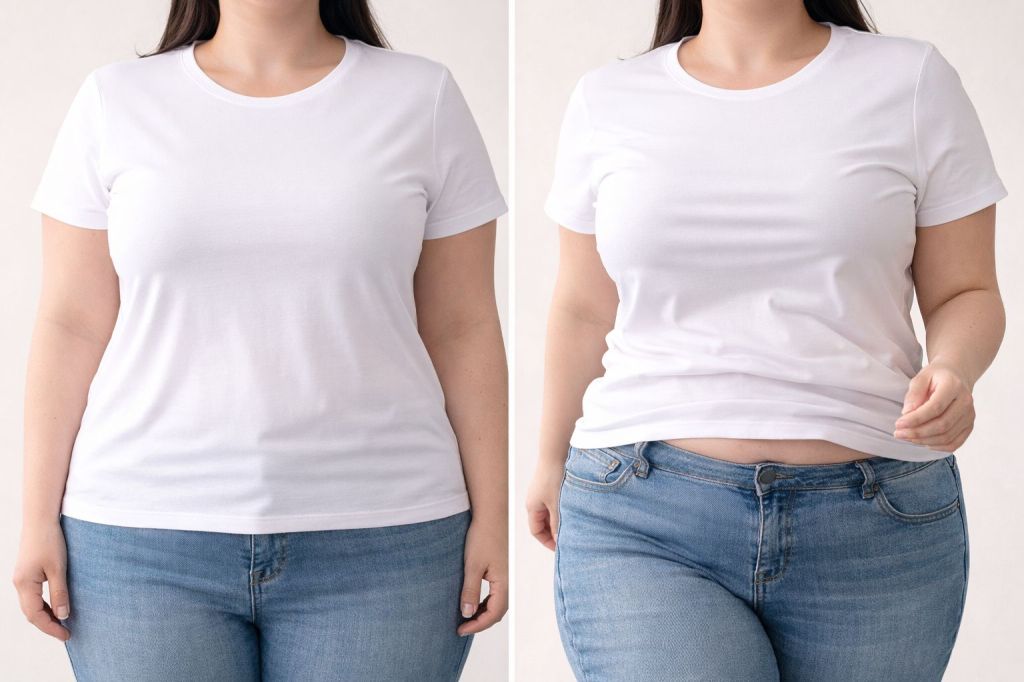
Most body-shape discussions try to place people into neat categories. In real life, bodies rarely work that way. What matters more than labels is where volume tends to sit — and how it is distributed across the body.
The patterns below describe common ways bodies carry volume. Many people will recognize themselves in more than one section. That is normal.
Bust-dominant distribution
(often referred to as “top-heavy” or part of an “hourglass”)
In this pattern, a larger share of the body’s volume sits in the chest and upper torso. From the front and side, the bust is visually prominent. The ribcage and upper back may also appear broader, while the waist, hips, legs, or arms may be slimmer or more evenly proportioned.
This distribution is often present on its own, but it frequently overlaps with abdominal fullness or upper-back width.
Common overlaps
- Bust-dominant + waist-dominant
- Example: “I have a big bust, but my middle is not flat either.”
- Bust-dominant + upper-body dominant
- Example: “My chest and upper body feel heavy compared to my hips and legs.”
Waist-dominant or abdominal distribution
(often called “apple,” “round,” or “O-shape”)
Here, volume is concentrated around the midsection. The torso appears wider from the front and side, while arms and legs may be slimmer or evenly proportioned. Abdominal fullness can be carried primarily in the front, evenly around the waist, or lower in the torso. Some people describe this as a “round” or “central” shape, but the distribution varies from person to person.
This pattern often overlaps with a fuller bust.
Common overlaps
- Waist-dominant + fuller bust
- Example: “My belly and my bust are the fullest parts of my body.”
- Waist-dominant + upper back
- Example: “My shoulders and upper body are broad, and I also have a fuller middle.”
- Waist-dominant + hip fullness
- Example: “I carry weight in my belly and my hips at the same time.”
Hip- or seat-dominant distribution
(often called “pear,” “A-shape,” or “bottom-heavy”)
In this pattern, more volume sits in the hips, thighs, and seat. From the side, the body may show more depth at the back. From the front, the hip line is more pronounced. The waist and upper body may appear smaller or more evenly proportioned by comparison.
This distribution can exist alone or alongside abdominal or bust fullness.
Common overlaps
- Hip-dominant + waist-dominant
- Example: “My lower body is full, and my waist is not clearly defined.”
- Hip-dominant + balanced upper body
- Example: “My hips and behind are the largest part of me, but my upper body feels fairly even.”
Upper-body dominant distribution
(often called “inverted triangle” or “V-shape”)
Here, volume is concentrated in the shoulders, upper back, ribcage, or upper torso overall. The lower body — hips, thighs, and legs — may appear slimmer or less prominent in comparison. Bust size may be moderate or smaller, but upper-body width is visually dominant.
This pattern is sometimes described as “top-heavy,” but that term often oversimplifies what is really a ribcage and shoulder-based distribution.
Common overlaps
- Upper-body dominant + abdominal fullness
- Example: “My shoulders and upper body are broad, and my belly is also where I carry weight.”
- Upper-body dominant + bust fullness
- Example: “My chest and upper body are the most noticeable parts of me.”
Balanced or evenly distributed volume
(often called “hourglass” or “rectangle,” depending on proportions)
In this pattern, volume is spread more evenly across the bust, waist, and hips. No single area stands out strongly from the front or side. This distribution is less common than many fashion discussions suggest, but it does exist.
Even in balanced bodies, smaller overlaps still occur — no body is perfectly uniform.
Common overlaps
- Balanced + mild abdominal fullness
- Example: “Most of me is evenly sized, but my belly sticks out more than the rest.”
- Balanced + mild hip or bust fullness
- Example: “My body is fairly even, except my chest is much larger.”
Most bodies are mixed
Many people do not fit cleanly into one pattern. These mixed distributions are not exceptions. They are common — and expected.
Understanding body distribution as overlapping zones — rather than fixed shapes — allows for a more accurate and realistic view of real bodies.
Why this matters
Before discussing clothing, fit, or construction, it helps to understand how bodies actually carry volume.
This overview is meant to provide a shared language — not to suggest changes, solutions, or ideal outcomes.
Future articles will explore how garments interact with these distributions and why certain issues tend to appear. This article establishes the foundation for those conversations.

 WeAllPS