Many clothes are designed to look right in one moment and fail everywhere else.
If you’ve ever thought, “It looked fine when I tried it on” — and then felt uncomfortable, distracted, or disappointed after wearing it for an hour — you’re not imagining things.
This is not a confidence issue.
It’s a design problem.
The Mirror illusion
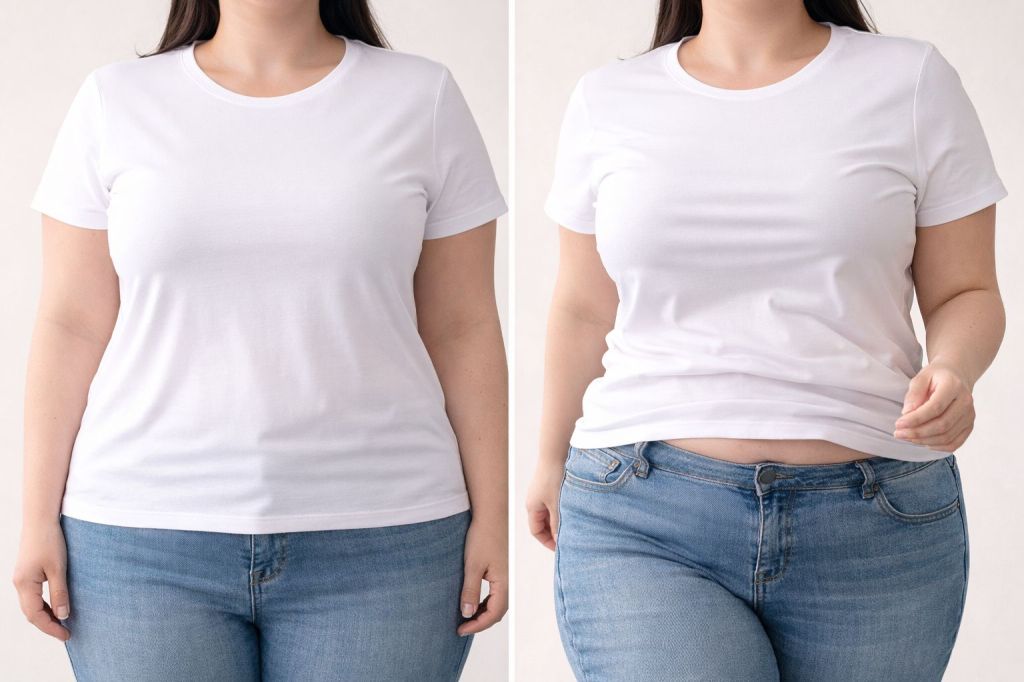
Most clothing is evaluated in a static position: standing still, facing forward, shoulders back, stomach held in. This creates a false sense of fit.
Real bodies do not stay still.
They sit, walk, bend, breathe, and shift.
When a garment is not built for movement, it collapses the moment life happens.
Why this happens so often in plus-size clothing
The failure isn’t about size — it’s about construction priorities.
Many garments are designed to: look smooth from the front, photograph cleanly, hang neatly on a hanger.
They are not designed to: move with fuller hips or thighs, accommodate softer stomachs, support heavier busts without distortion, adapt to short or long torsos
So the garment “passes” the mirror test — and fails the reality test.
Common real-life failures women experience
These patterns repeat constantly:
- Dresses that twist or ride up once you walk
- Waistbands that roll after sitting
- Tops that pull forward because of bust weight
- Skirts that cling in motion but look fine standing still
- Fabric that collapses into the stomach or hips after minutes of wear
None of these show up in a fitting room mirror.
All of them show up in real life.
How these patterns are identified
The observations on this site are not based on styling theory or trend cycles.
They come from repeated real-world analysis:
- watching how garments behave on different bodies over time
- noting where fit breaks down in movement, not mirrors
- and tracking the same failures across environments, brands, and sizes
The core problem: static fit vs functional fit
Most clothing is tested statically.
Very little is tested dynamically.
Static fit asks:
“Does this close? Does it lie flat? Does it photograph well?”
Functional fit asks:
“What happens when a body moves?”
For many plus-size bodies, this question is never asked — which is why so many clothes feel unpredictable and exhausting to wear.
Why this matters
When clothes fail in motion, women often internalize the failure:
- “Maybe I need shapewear.”
- “Maybe I chose the wrong size.”
- “Maybe this style just isn’t for me.”
But the issue is not taste or discipline.
It’s that the garment was never built to function on a real body.
What actually helps
While no single garment works for everyone, certain design principles consistently reduce real-life fit failure:
- Vertical support beats tight waistbands
Clothes that rely on seams, panels, or drape tend to stay in place better than those that squeeze the body horizontally. - Flexible structure works better than stiffness
Light structure with some stretch adapts to sitting, walking, and breathing more reliably than rigid shaping. - Cuts that allow movement last longer
A-line, wrap, and bias-cut garments handle motion better than straight, static silhouettes. - How something is built matters more than the size label
A well-constructed garment in the “wrong” size often works better than a poorly made one in the “right” size.
At WeAllPS, the focus is on observation:
- how garments behave over time
- how they respond to movement
- where and why they fail on real bodies
Future articles will break this down further:
- by body shape
- by garment type
- by construction detail
- and by tools that claim to “solve” these problems
The goal is not to find perfect clothes.
It’s to make fit predictable.
No body is wrong.
But many clothes are.

 WeAllPS