How to spot bust pull before buying anything
Most fit problems are discovered too late. By the time a garment starts riding up, pulling forward, or demanding constant adjustment, it has already been bought, worn, and quietly downgraded in the wardrobe.
Bust pull is one of those problems. It rarely announces itself in the fitting room. Instead, it emerges later—while walking, sitting, or reaching—when the garment is asked to move with the body rather than simply rest on it.
The difficulty is not that bust pull is subtle. It’s that most people are taught to look for it in the wrong way.
Why fitting rooms are unreliable
Fitting rooms encourage stillness. You stand upright, face a mirror, and assess how something looks in a paused moment. In that context, gravity is doing most of the work. The fabric hangs, the hem appears level, and the neckline seems stable.
But bust pull is not a static problem. It is a balance problem that only becomes visible when the body moves forward, shifts weight, or changes posture. A garment can appear fine at rest and still be structurally unable to accommodate forward volume once motion begins.
This is why bust pull often feels confusing. The garment did not look wrong when you tried it on. It only began to fail later.
What to look for instead
To spot bust pull before buying anything, the question is not “Does this fit?”
The question is “How is this garment managing front-to-back balance?”
There are a few consistent signals that reveal the answer.
1. Front length disappears first
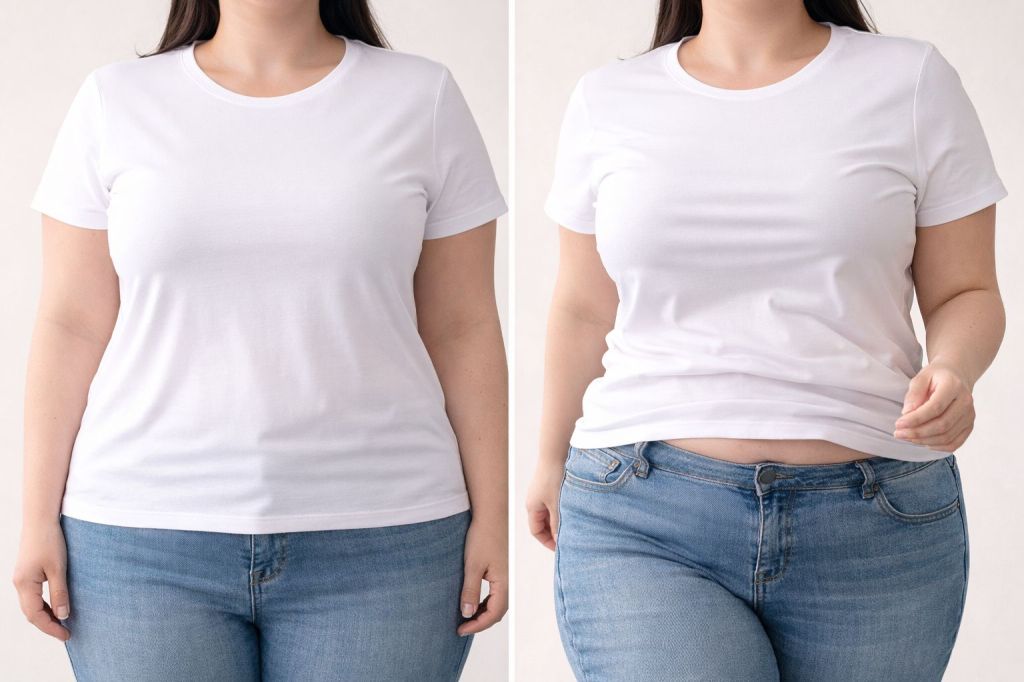
When a garment is pulled forward by the bust without enough shaping or length to absorb that volume, the front hem shortens. The back remains in place while the front lifts.
If a top already feels borderline short in front while standing still, movement will exaggerate that imbalance.
2. The neckline migrates forward
Necklines affected by bust pull tend to drift forward or downward during motion. This is not about cleavage. It’s about the garment rotating around the body because the front cannot hold its position under tension.
A neckline that feels stable only when you are upright and still is not actually stable.
3. Horizontal tension appears across the bust
Wrinkling or tightness running straight across the bust—rather than shaping that follows the body—often indicates that width has been added without structure.
This tension is a sign that the fabric is resisting forward volume rather than accommodating it.
4. Sleeves rotate toward the front
When the front of a garment is pulled forward, sleeves often twist subtly toward the chest. This is a secondary effect, but a reliable one. Sleeve rotation is rarely a sleeve problem on its own; it usually reflects imbalance elsewhere.
5. The garment requires “management”
If you find yourself instinctively smoothing the front, pulling the hem down, or checking coverage after small movements, the garment is already asking for ongoing correction.
That behavior does not improve with wear. It intensifies.
The key distinction
Bust pull is often treated as a sizing issue. The instinctive response is to size up, layer, or adjust.
But bust pull is not primarily about size. It is about construction that does not account for forward volume with corresponding shaping and length.
Once you notice this, you’ll start seeing the same failure repeat across brands, sizes, and price points—often before you try anything on.
That repetition is not accidental. It reflects how garments are commonly graded and constructed, especially when additional width is added without front-specific design changes such as darts, seams, or added length.
What changes once you see it
Learning to spot bust pull does not mean you will suddenly find garments that never fail. But it does change the timing of the failure.
Instead of discovering the problem after purchase, you begin to recognize it early—sometimes immediately. You notice where length is missing, how fabric behaves across the front, and whether the garment has any structural mechanism to manage forward volume.
This does not produce quick fixes. It produces clarity.
And that clarity shifts the experience of getting dressed. The frustration moves away from the body and toward the garment, where it belongs. What once felt unpredictable starts to look consistent, even obvious.
The garment did not change.
Your ability to see it did.
Applying this while shopping
Once forward shift and bust pull become recognizable, the next challenge is applying that awareness while browsing online, before buying, not after.
Over time, the same signals appear repeatedly: how seams are shaped, how fabric falls, whether a garment is built to allow projection rather than resist it. These patterns are not isolated incidents but recurring construction choices.
To make those observations easier to use in real shopping situations, WeAllPS translated them into a simple evaluation filter designed to be used while reviewing product pages.
You can find it here.

 WeAllPS