We’ve all been there.
You try on a blouse in the fitting room. It fits. It looks great in the mirror. You buy it, feeling like you’ve finally found “the one.”
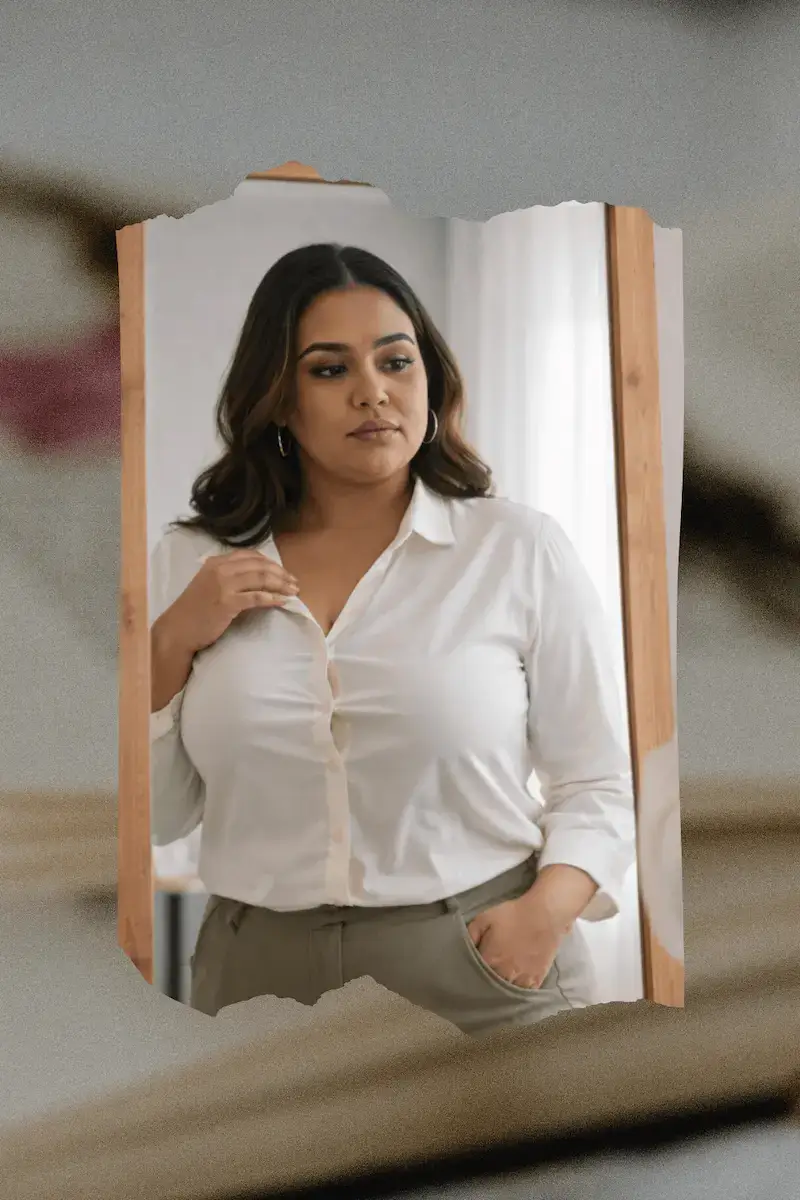
But an hour into wearing it, the betrayal begins. The front starts shifting. The fabric pulls across your chest. You find yourself tugging the hem down or adjusting the neckline every five minutes.
At first, it feels like a sizing issue. You think, “Maybe I should have gone up a size?” But usually, it isn’t about size at all. It’s about structure.
The “Going Up a Size” Trap
When a top feels tight across the bust, most brands solve it by simply adding width. They make the shirt wider, looser, and longer.
While that works for a relaxed t-shirt, it fails for structured blouses. Why? Because the human body isn’t a flat rectangle – it’s 3D. When you have more volume at the bust, the fabric doesn’t just need to go wider around your ribs; it needs forward space to travel over the curve.
Without that dedicated space:
- The Pull: Fabric strains horizontally across your chest.
- The Hike: The front hem lifts higher than the back.
- The Shift: The garment stops moving with you and starts fighting you.
This is the “Forward Shift” problem. Even if a top looks fine while you’re standing perfectly still, it will fail the moment you actually live your life in it.
So, What Exactly Is a Bust Dart?
Think of a bust dart as a tiny piece of 3D engineering.
Visually, it’s just a small, wedge-shaped seam starting near the armpit or side seam and pointing toward the bust. But its job is massive: It turns a flat piece of fabric into a curved shape.
By “pinching” a small amount of fabric at the side, the dart:
- Creates Forward Depth: It allows the fabric to “turn the corner” around your curve.
- Eliminates the “Tent” Effect: It removes the excess fabric under the arm, letting the shirt drape naturally toward your waist.
- Locks the Fit: It anchors the garment so it stays put when you move your arms.
A dart doesn’t make a garment tighter—it makes it more accurate.
Why Darts Are the “Ninjas” of Online Shopping
Here is the frustrating part: Bust darts are nearly invisible in product photos. Retailers don’t always want you to see the construction; they want you to see the “vibe.” When we analyzed dozens of tops online, we noticed three things that hide these crucial details:
- The “Size Up” Model: Models often wear a size too large, so the garment hangs loosely enough to hide the lack of shaping.
- The Pattern Camouflage: Busy prints and dark colors (like navy or black) swallow the seam lines.
- Post-Production: High-contrast lighting or retouching can smooth out the very lines you’re looking for.
If you’ve never noticed them before, don’t worry – you weren’t supposed to.
How to Spot a Dart (The Pro-Shopper’s Guide)
Spotting a dart online is a skill, and like any skill, it gets easier with practice. When you’re browsing, don’t just look at the overall “look.” Zoom in on the side seam, about 2-3 inches below the armpit.
- Look for the Diagonal: Check for a faint line pointing toward the chest.
- Follow the Grain: Look at the fabric’s weave or print. Does it subtly change direction? That’s a sign of a dart.
- Check the Side Profile: If there is a photo of the model from the side, look at the hem. If the hem stays perfectly level from front to back, there is likely a dart doing the heavy lifting.
If They’re So Great, Why Are They Missing?
You might notice that many modern shirts don’t have darts at all. If they solve so many problems, why leave them out? It usually comes down to two things: speed and cost.
- Production Shortcuts: Sewing a dart requires precision. It takes extra time and extra thread. For “fast-fashion” brands, skipping the dart means they can sew shirts faster and cheaper.
- The “Baggy” Fix: Instead of tailoring the shirt to fit a human shape, brands just make the whole garment wider. They hope you’ll accept a “boxy” or “baggy” fit as long as it buttons up.
Basically, they are saving money by giving you less shape.
Putting Your Eye to the Test: 3 Real-World Examples
Since most fashion photography isn’t designed to show off construction, you have to know how the “camouflage” works. Here is how to spot the difference between a shirt built for a body and a shirt built for a flat surface.
How to recognize a bust dart instantly
Look under the arm → is there a diagonal seam? If yes → shaping exists If no → fabric is flat → high risk
Example 1: The Geometric “Glitch”

Original product available on their website.
When you are looking at a geometric pattern like stripes, finding the dart is actually easiest.
- How to spot it: Look for the “glitch” in the lines. In the zoom-in, you can see the horizontal pink stripes suddenly tilt or “V” into a diagonal seam.
- Why it’s there: That seam is pulling the fabric together to create a pocket of forward space. Without it, those stripes would likely look wavy and distorted across your chest.
Example 2: The Pattern “Break”

Original product available on their website.
On a bold, organic print like this one, a dart is much harder to find because there are no straight lines to follow. This is where most shoppers give up and assume there is no shaping.
- How to spot it: Look for the “cut.” As shown in the zoom-in, there is a clean, diagonal line that literally slices through the blue abstract shapes.
- The Result: This is a sign of high-quality construction. The brand didn’t just print a pattern on a sack; they tailored the fabric after printing it to ensure the blouse follows the curve of your ribs.
Example 3: The “Hike” (When Darts are Missing)

Original product available on their website.
When a dart is missing, the garment doesn’t just look “loose”—it actually fails to hang correctly.
- The Clue: Look at the side seam—it’s a perfectly flat, straight line. There is no dart.
- The Consequence: Because there is no 3D shaping for the bust, the fabric is forced to travel a longer distance over the chest. It “steals” that extra length from the bottom of the shirt, causing the hem to lift.
- The Proof: See how the bottom of the shirt curves upward in the center? That “Hike” is the smoking gun. In real life, this top will likely feel like it’s constantly sliding backward or needs to be tugged down every few minutes.
“Without a dart, the garment is forced to stretch or pull. With a dart, it is allowed to shape.”
Why This Changes Everything
If a garment lacks this shaping, it will either pull at the chest or be “oversized” everywhere else just to fit your bust. This is why so many tops look like they fit in photos but feel like a costume in real life.
If you’ve ever felt like you constantly need to pull your top down, or felt “frumpy” in a shirt that should fit, this is likely the culprit.
Final Thought
Understanding bust darts isn’t about finding “better” clothes; it’s about understanding how clothes are built for your body. No body is “wrong.” But many garments simply aren’t constructed with a 3D shape in mind. Once you stop guessing and start looking for these small structural details, you stop buying clothes that “might work” and start choosing pieces that actually do.
Want to sharpen your shopping eye even further?
Check out our guide on How to Evaluate Shirt Fit Before Buying Online